What Happens in an EMDR Session?
By Alex Aslan | Registered Psychologist, Sydney CBD
What Is EMDR?
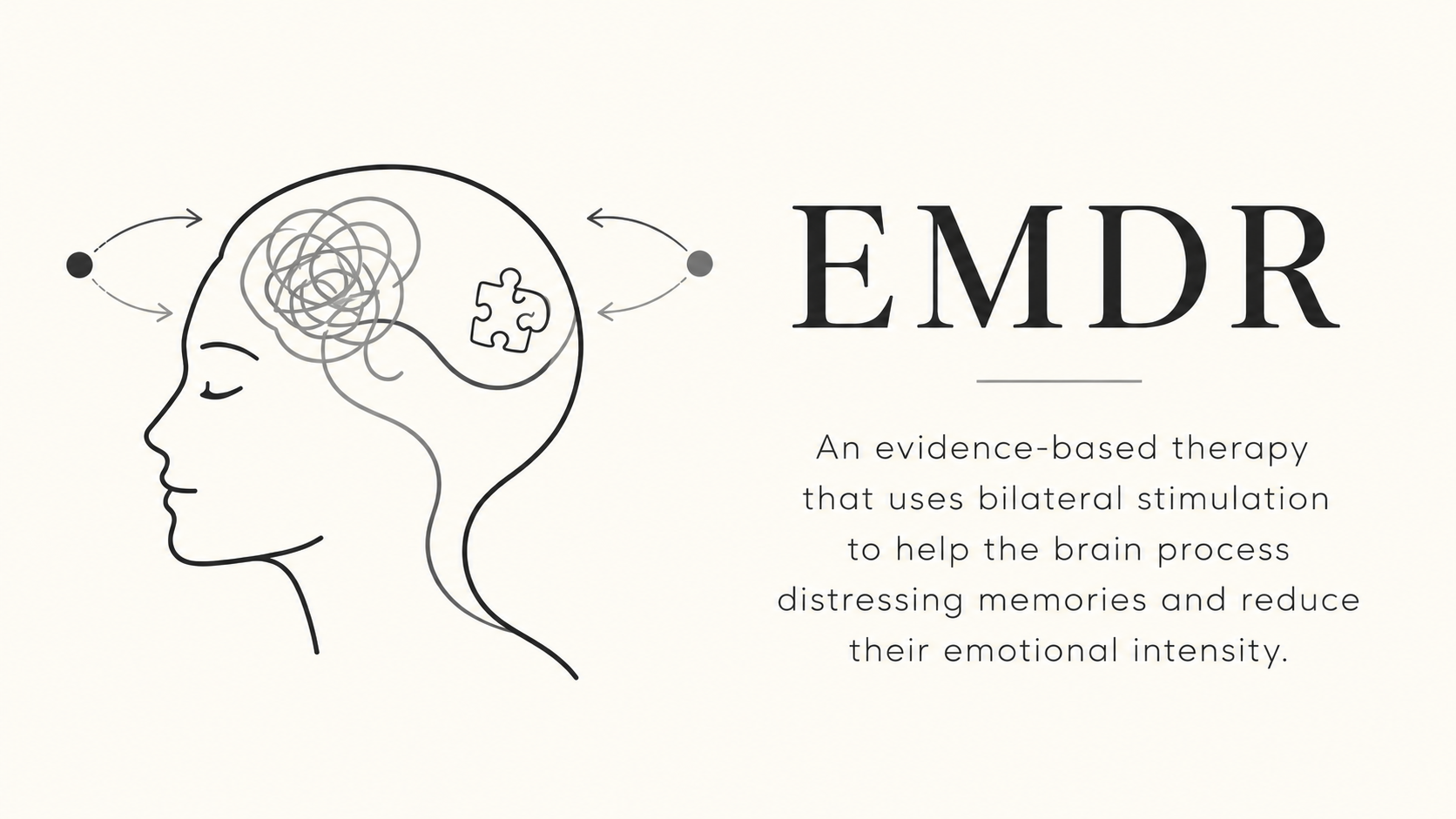
Eye Movement Desensitisation and Reprocessing (EMDR) is a trauma-focused therapy in which a person briefly holds a distressing memory in mind while following a bilateral stimulus. This is usually eye movements tracking a moving light or the therapist’s fingers, although alternating taps or tones can also be used. One leading explanation for why this helps is that attending to the stimulus while recalling the memory divides working memory, and memories held under that load tend to become less vivid and less emotionally charged.
The precise mechanism is still debated, but the evidence for outcomes is strong enough that the Australian Guidelines for the Prevention and Treatment of Acute Stress Disorder, PTSD and Complex PTSD (Phoenix Australia, 2020) include EMDR among the recommended treatments for adults with PTSD.
The First Sessions: History and Preparation
Although EMDR is best known for its eye movements, the work begins well before they are introduced. The first session, and sometimes the second, is usually devoted to understanding what has brought the person to therapy. A psychologist will typically ask about the events or periods of life that feel most unresolved, current symptoms, sleep, stress levels, substance use and sources of support, along with what has and has not helped so far.
Preparation follows naturally from this. The psychologist teaches grounding techniques that help the body settle, and the two agree on a stop signal, commonly a raised hand, so that the person can pause at any point and remains in control throughout. This stage is an important part of the treatment, because processing a memory brings emotion to the surface and people benefit from knowing they can bring it back down again. When trauma is longstanding or complex, preparation generally takes longer, and treatment moves forward only when the person feels ready.
Choosing a Target Memory
Once preparation is complete, a single memory is selected and broken into its components. A car accident offers a straightforward example:
The image: the headlights in the moment before impact
The negative belief: “I should have seen it coming”
The preferred belief: “I did the best I could”
The emotion and body sensation: fear, with a tight feeling in the chest
Two ratings: how distressing the memory feels at present on a scale of 0 to 10, and how true the preferred belief feels on a scale of 1 to 7
These ratings provide a baseline, and comparing them at the end of a session shows what has shifted. Importantly, none of this requires a detailed account of the accident. The therapist needs only enough information to identify the target, and the amount a person shares beyond that remains entirely their choice.
Processing
With the target identified, processing takes place in short sets of bilateral stimulation, each lasting around 30 seconds. After each set, the therapist invites the person to take a breath and describe whatever they notice, which might be a change in the image, a different memory, a physical sensation, or nothing in particular. Each of these is a normal part of the process, and there is no need for the person to interpret or explain what arises.
Throughout this phase, the therapist’s role is largely to stay out of the way, keeping the person anchored to the target, checking in on how they are coping, and following wherever the person’s mind goes, since the brain tends to move toward what it needs to work through. Over the course of a session, the memory often changes in recognisable ways. The image may fade or lose its sharpness, the physical reaction usually eases, and the belief attached to the memory begins to shift. In the car accident example, “I should have seen it coming” might gradually give way to “it happened quickly and I responded as well as anyone could have”.
Progress does not always follow a steady downward line, and it is common for emotion to rise briefly before it settles. Some memories also need more than one session, and in that case a careful therapist will close at a safe point rather than push through.

Closing the Session
Each session ends with grounding, regardless of whether the memory has been fully processed. The therapist checks how settled the person feels before they leave and explains what might happen between appointments, which can include vivid dreams, shifts in mood or other memories surfacing. These reactions are common as the brain continues to process, and a brief note of anything that comes up is often helpful to bring to the next session. At that session, the memory is re-checked against the baseline ratings, and the work either moves to the next target or continues on the same one.
How many sessions will it take?
The number of sessions depends on what is being addressed. A single, well-defined event often requires fewer processing sessions than several events or trauma that has accumulated over years, and preparation adds time on top of that. After the first session or two, a psychologist can usually offer a more realistic estimate based on the person’s history rather than a general figure.
Getting started
If you're based in Sydney and would like to discuss whether therapy might be useful for what you're dealing with, get in touch here. In-person sessions available in Sydney CBD and via telehealth across Australia.
Alex Aslan is a registered psychologist (MPsych Clinical, Distinction) based in Sydney CBD, specialising in men's mental health, anxiety, trauma, and performance psychology. He also works with the NSW Police Force supporting officers and first responders navigating occupational trauma and chronic stress.
