Men’s Mental Health in Australia
By Alex Aslan | Registered Psychologist, Sydney CBD
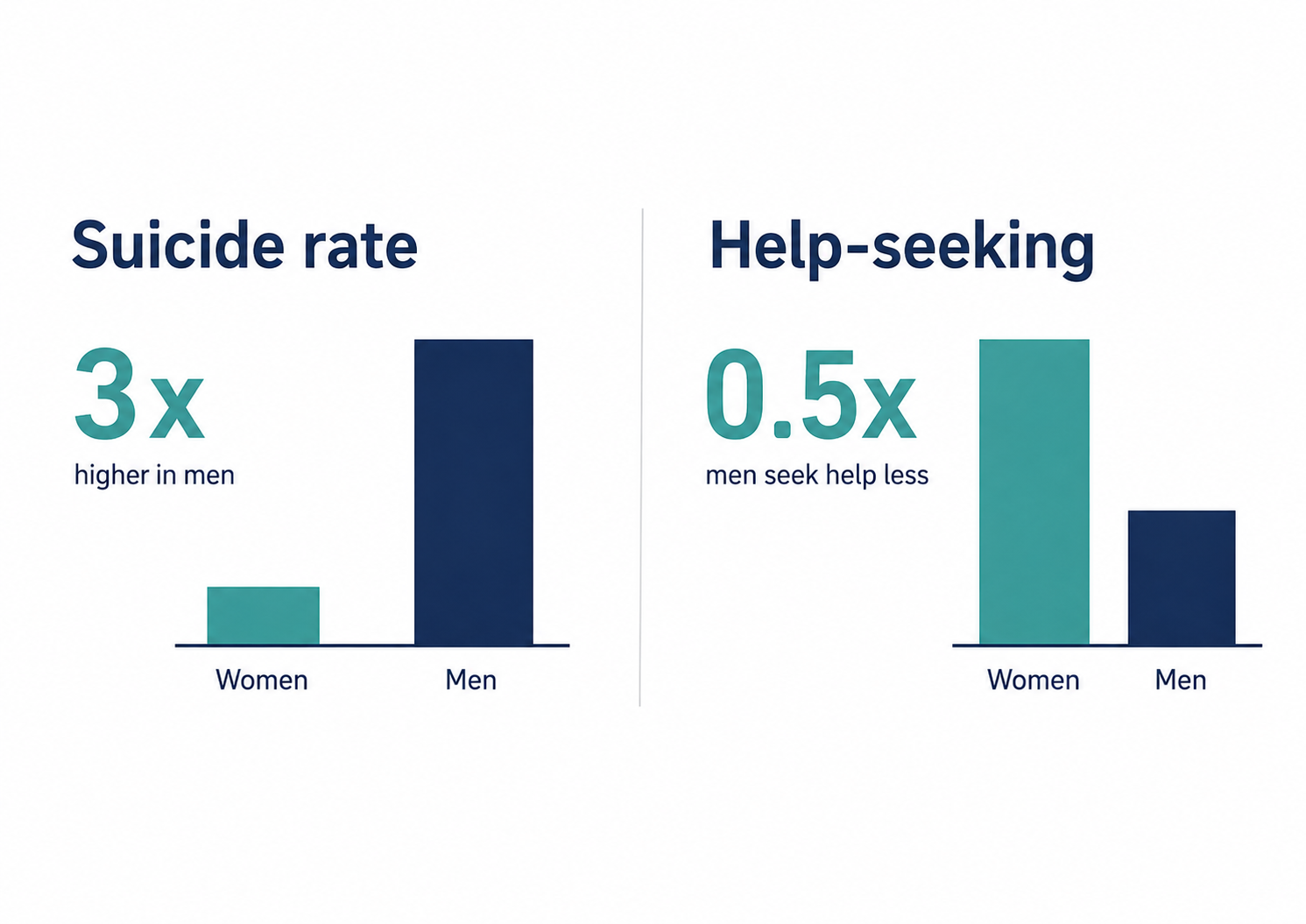
Men die by suicide at three times the rate of women in Australia. They present to mental health services at roughly half the rate. The gap between need and help-seeking is not subtle, and it has not meaningfully closed despite decades of public awareness campaigns.
The Standard Explanation Falls Short
The standard explanation for men’s mental health challenges, is that they are socialised to suppress emotions, taught that vulnerability is weakness, and too proud to admit they're struggling.
While this may be true for some, in practice this doesn’t appear to be the only reason men avoid help seeking. Another explanation is that many men do not feel that they have a clear model of what therapy involves, what it's supposed to do, or whether it maps onto the kind of problem they're actually experiencing. There is often a misconception that therapy entails endlessly speaking about your emotions without a clear trajectory to improvement. Essentially, complaining without doing anything about it.
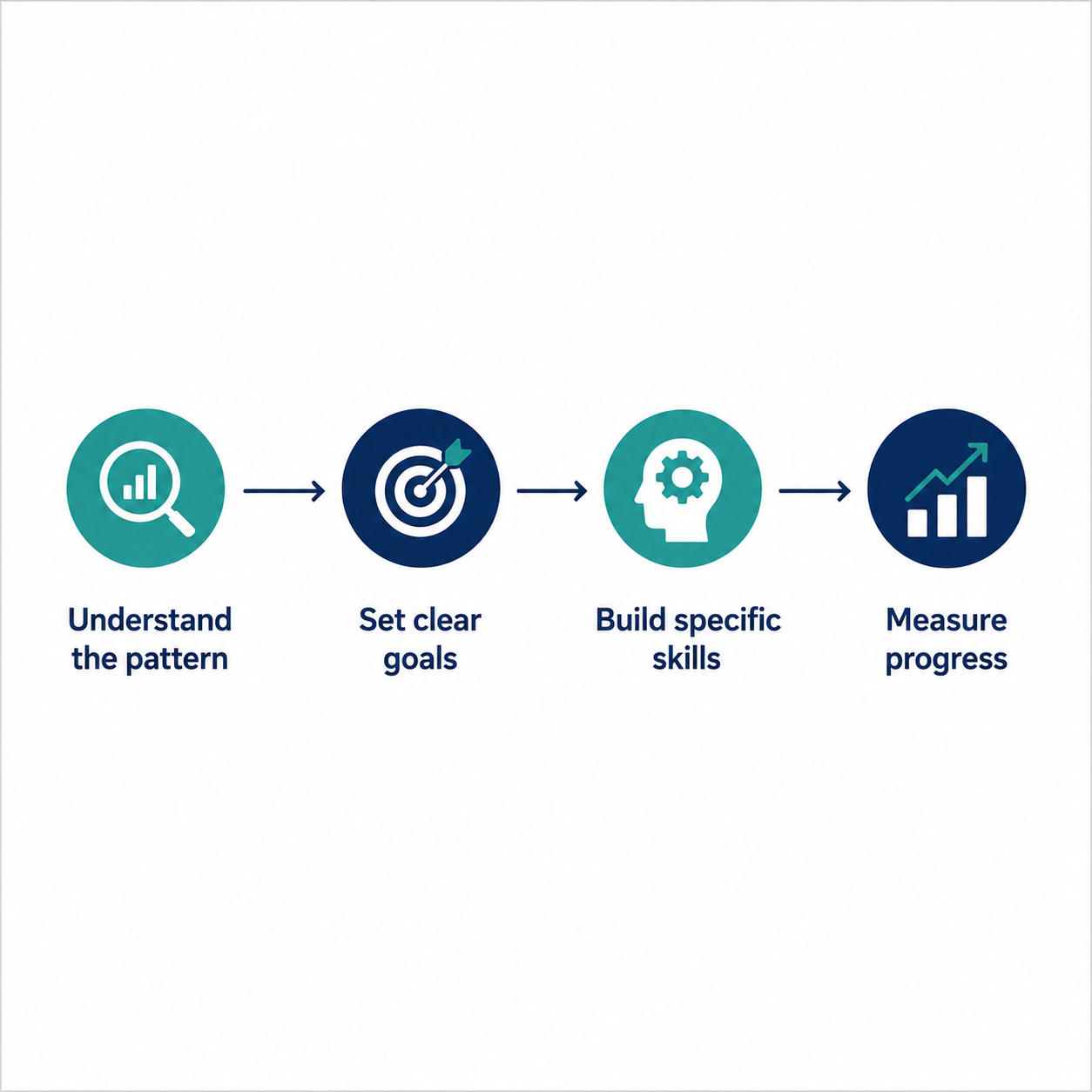
In reality, this couldn’t be any further from the truth. Effective therapy is structured and goal-directed. Approaches like CBT, ACT, and Schema Therapy are built around understanding what's driving the problem and making concrete changes, not open-ended conversation without direction.
What's Actually Happening Underneath
When men don't seek help, three things tend to be operating simultaneously.
The first is alexithymia — difficulty identifying and describing emotional states. Research consistently finds higher rates of alexithymia in men, which is partly developmental (boys are socialised to externalise rather than introspect) and partly neurological. A man who can't name what he's experiencing is genuinely less likely to recognise it as something a psychologist could help with. He notices the irritability, the disconnection, the flatness - but he doesn't label it anxiety or depression.
The second is externalisation. Male distress tends to manifest behaviourally rather than emotionally - increased alcohol use, risk-taking, withdrawal, anger, overwork. The problem is that externalised distress doesn't look like a mental health problem, either to the man experiencing it or to the people around him. It looks like a character issue, a discipline failure, or just a personality trait. Nobody refers you to a psychologist for working too hard or drinking a bit too much, even when those things are symptoms of something worth treating.
The third is the help-seeking model. Men are more likely to seek assistance for a concrete problem with a defined solution, which is, incidentally, a reasonable way to approach most problems. Therapy, as it's typically described, doesn't match this model. It sounds indefinite, exploratory, and focused on the past rather than the present. Research by Zac Seidler at the University of Sydney found that men respond significantly better to therapy framed around specific goals and transparent processes. "Tell me what's wrong, what we're going to do about it, and roughly how long it will take" is not an unreasonable request. Most therapy services don't lead with that framing.
Why High-Performing Men Are Particularly at Risk
There is a specific version of this problem that I see regularly: men who are functioning extremely well by external measures and carrying something significant privately.
These are men who have learned to perform under pressure. They've built a self that functions efficiently in the world - disciplined, capable, and reliable when needed. While this is a valuable skillset, it is also a liability leading to higher likelihood of burnout.
The same psychological architecture that makes someone effective under chronic stress, makes it harder to recognise when the system is starting to fail. What typically brings these men in is not a moment of collapse. It's a gradual awareness that something isn't working the way it used to. Performance starts to decline — at work, in the gym, in relationships, in the bedroom. Sleep deteriorates alcohol use increases, there’s a consistent flatness or apathy that doesn’t seem to go away. Sometimes this change has been so gradual that this has become their new baseline without them realising it.
What Are The Benefits of Psychological Therapy?
The research on this is clear - when men engage with psychological treatment that is structured, goal-directed, and transparent about the process, outcomes are comparable to women's. The gender gap in outcomes largely disappears when the treatment approach accounts for how men actually present.
Men who engage in therapy typically report that the first shift is cognitive — understanding the mechanism behind what they've been experiencing. Understanding that anxiety is a threat-response system misfiring, not a character flaw. Understanding that the irritability and disconnection are symptoms of something treatable, not just how they are. Naming the pattern doesn't necessarily solve it, but it changes the relationship to it. Something that was experienced as a fixed feature of the self becomes something that can be worked with.
The second shift is behavioural. Structured approaches — CBT, ACT, exposure-based work — give men something concrete to do between sessions. A client who comes in expecting to just talk about his feelings and instead leaves with a clear model of what's happening and a set of practices to apply is far more likely to return than one who didn't know what he was walking into.
The third shift, when the work goes deeper, is harder to name. It has something to do with what Carl Rogers described as becoming more fully oneself — closing the gap between the version of themselves that functions in the world and something more authentic underneath it. Many men have spent so long performing a particular version of themselves that they've lost track of what they actually think, feel, or want. That disorientation has costs that are worth taking seriously.
Finding a Male Psychologist in Sydney
There is reasonable evidence that some men benefit from working with a male psychologist — not because male therapists are superior, but because shared cultural context can reduce the anxiety around engaging and create more shared understanding. The sense that the person across from you has some firsthand understanding of what it is to be a man navigating the pressures you're describing can create a strong therapeutic alliance.
If you're looking for a male psychologist in Sydney, a few things are worth noting:
Check AHPRA registration. All registered psychologists in Australia are listed on the AHPRA register. Anyone calling themselves a psychologist without being registered is operating outside the law.
Ask about their approach upfront. A psychologist working with men's mental health should be able to tell you clearly what framework they use, how they'd approach your specific concern, and roughly what to expect.
Consider telehealth. For many men, particularly those in demanding roles, the logistics of getting to an in-person appointment are a genuine barrier. Telehealth delivers equivalent outcomes for most presentations and removes the friction. Evening and weekend appointments are available if scheduling is the issue.
Medicare rebates are available through a Mental Health Treatment Plan from your GP — meaning the cost of seeing a psychologist is significantly lower than most people assume.
If you're based in Sydney and would like to discuss whether therapy might be useful for what you're dealing with, get in touch here. In-person sessions available in Sydney CBD on Saturdays and via telehealth on weeknights across Australia.
Alex Aslan is a registered psychologist (MPsych Clinical, Distinction) based in Sydney CBD, specialising in men's mental health, anxiety, trauma, and performance psychology. He also works with the NSW Police Force supporting officers and first responders navigating occupational trauma and chronic stress.
